Negotiation Skills Training in Dubai: A Complete Guide
Most salespeople in Dubai know the moment. The client loved the demo, the proposal went out on Monday, and by Wednesday the WhatsApp message arrives: "Can you do something on the price?"
What you do next decides whether you protect your margin or quietly give it away. That's really what negotiation skills training is for.
In short, negotiation training gives you a method for preparing, opening, trading and closing deals, so you're not relying on instinct when the pressure is on. Good courses cover ideas like BATNA, ZOPA and anchoring, then make you practise them. Our CPD-accredited Negotiation Skills course takes 4–5 hours online, followed by a 30-minute live scenario where you put it all to work.
Below, we'll walk through what you actually learn, why it matters so much here in Dubai, and how to pick a course that's worth your time.
What is negotiation skills training, really?
Strip away the jargon and it's simple: learning to get better outcomes from conversations where two sides want different things.
People tend to picture boardrooms and big contracts. In reality, most of us negotiate every week. A sales manager discussing renewal terms. A procurement officer pushing a supplier on delivery dates. A team leader asking for one more person on the team. A business owner sitting across from a landlord.
None of them would call it "negotiation". All of them would do better with a plan.
Why does negotiation matter more in Dubai?
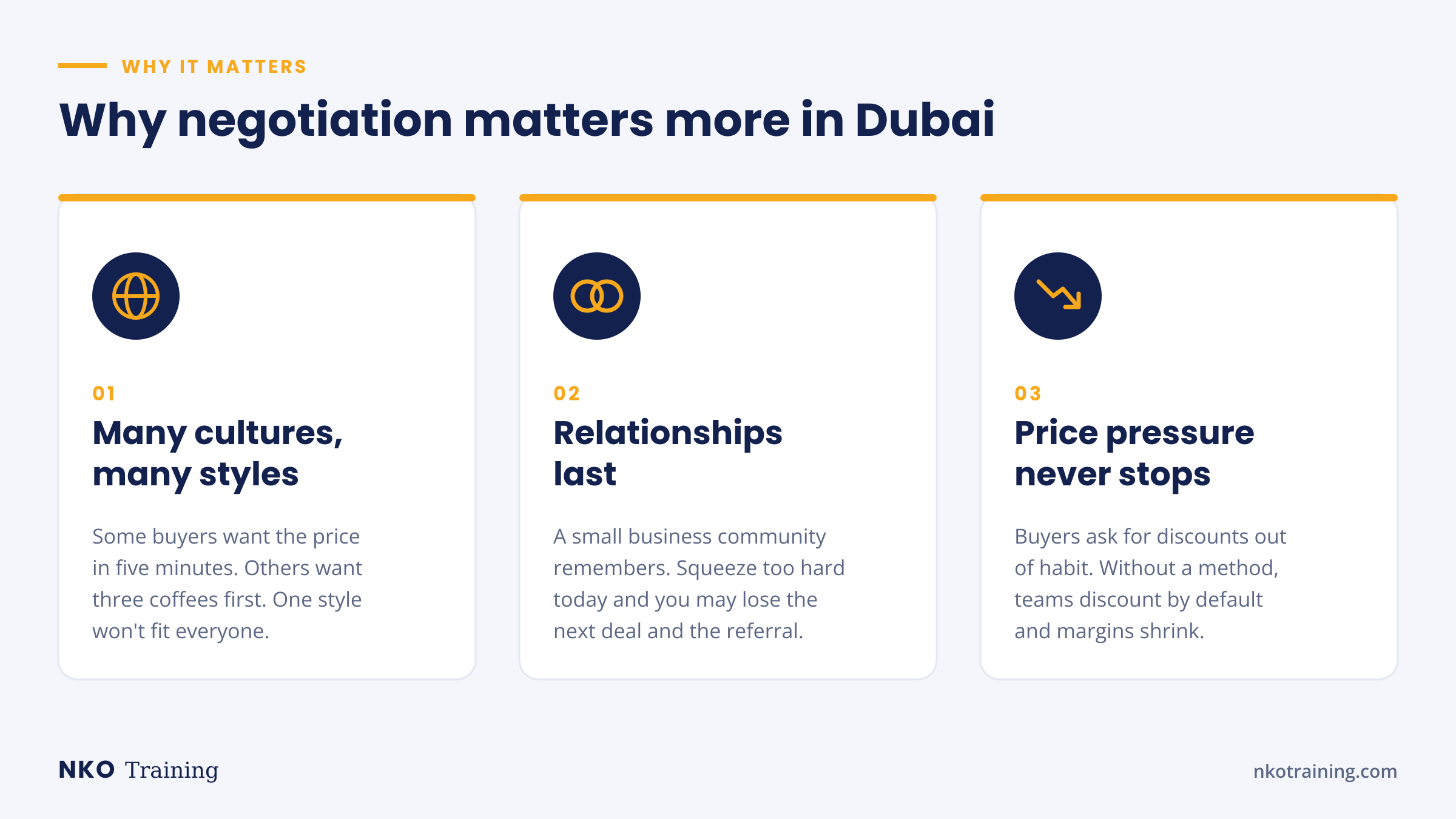
Working with teams here, three things come up again and again.
First, you're rarely negotiating with someone who shares your background. In one week you might deal with a buyer who wants the number in the first five minutes, and another who expects three coffees before prices come up. If you only have one style, you'll get one of them wrong.
Second, relationships last. Dubai is a big city with a surprisingly small business community. Squeeze a client too hard on one deal and you may not get the next one, or the referral that would have come with it.
Third, the price pressure never really stops. In real estate, retail and B2B services especially, buyers know they have options and ask for discounts out of habit. Teams without a method end up discounting by default, and that adds up fast over a year of deals.
What will you actually learn?
A decent course takes you from haggling to having a method. These are the ideas that do most of the heavy lifting.
BATNA: know your way out
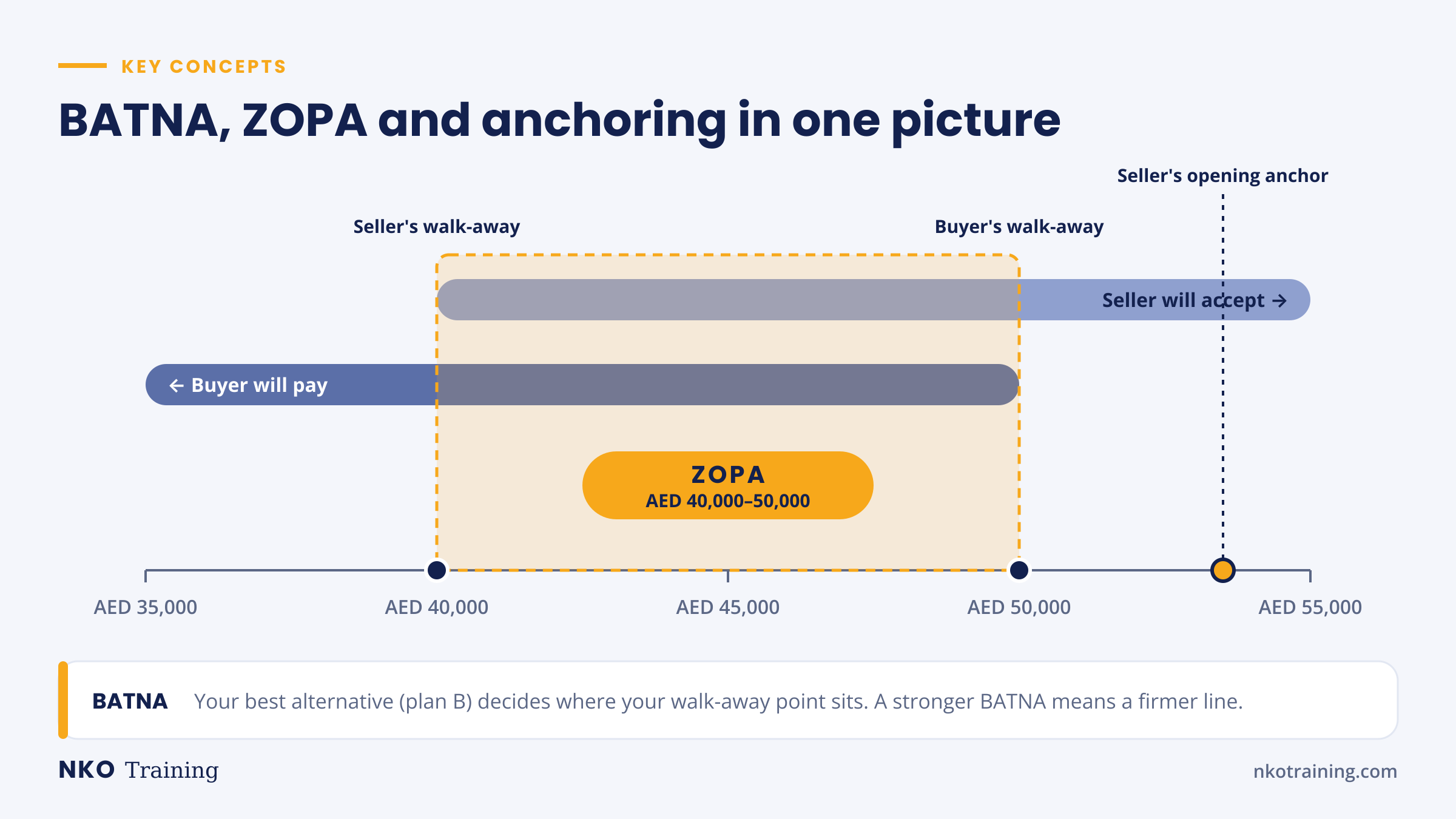
BATNA stands for Best Alternative To a Negotiated Agreement. Put simply, it's your plan B.
Say a supplier quotes 20% over your budget. If you already have a second supplier who can deliver in three weeks, that's your BATNA, and you'll negotiate very differently knowing it's there. People with a weak BATNA tend to cave. People who've never worked theirs out tend to bluff, and buyers can usually tell.
ZOPA and your walk-away point
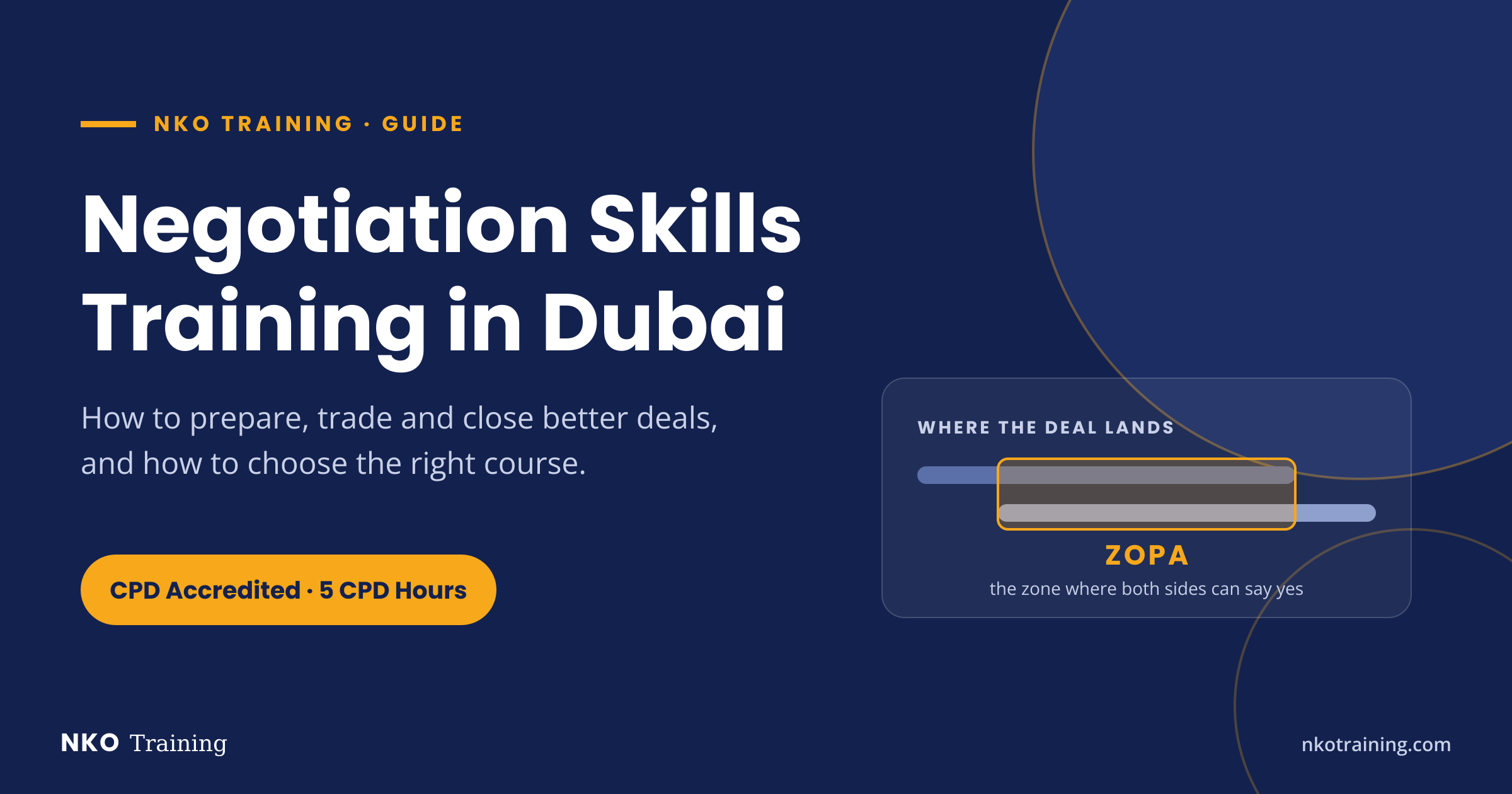
Your reservation point is the worst deal you'd still say yes to. The ZOPA, or Zone of Possible Agreement, is where your range overlaps with theirs.
If you won't go below AED 40,000 and the buyer can stretch to AED 50,000, there's a deal somewhere in between. The real question is where in that gap you land. Most people who "lose" a negotiation didn't lose the deal. They just ended up at the wrong end of it.
Anchoring
The first number on the table has a strange pull on everything that follows. It's called anchoring, and it works on experienced buyers too.
Open with a figure you can justify, and the conversation tends to circle around it. Wait for the other side to open low, and you'll spend the meeting clawing your way back up. Training teaches you when to go first, and what to do when they beat you to it.
What they ask for vs what they need
"We need 15% off" is a position. The reason behind it, maybe a fixed budget or a manager who wants a win, is the interest.
Once you know the interest, you have options that don't involve cutting your price: spreading payments, phasing delivery, adding training or support. Often the client is just as happy, and your margin survives.
Trading, leverage and handling pressure
Good negotiators rarely give anything away for free. If they move, they get something back. You'll also learn to spot your own leverage (there's usually more than you think) and to stay steady when someone says, "I need an answer by 5pm."
Closing so it stays closed
Plenty of deals fall apart after the handshake because each side remembers it differently. A short written summary, sent the same day, saves a lot of awkward follow-up calls.
What should you say when a client says "your price is too high"?
It's the line every salesperson dreads. Here's an approach you can try on your very next call:
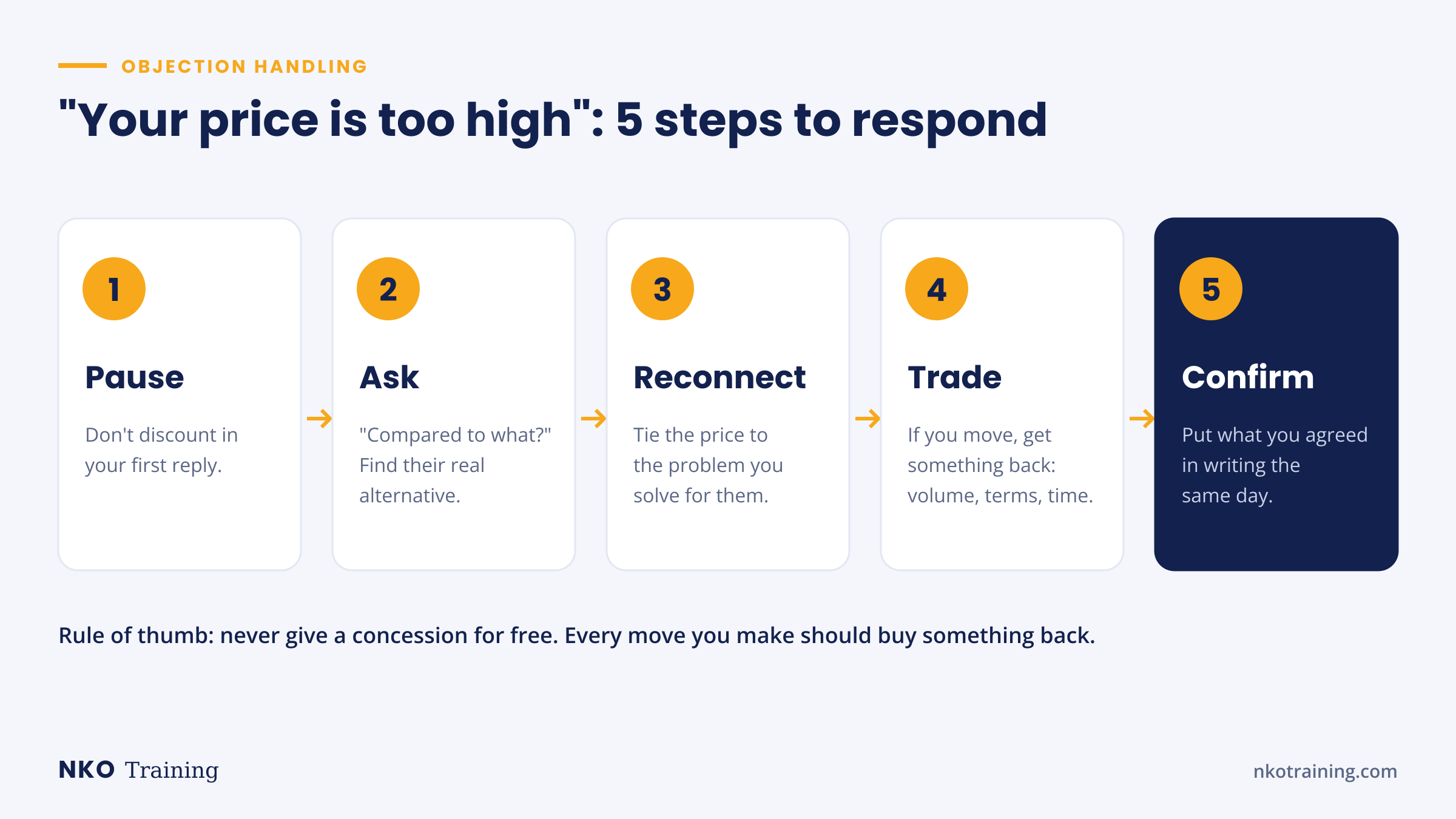
- Don't jump to a discount. If you drop the price in your first reply, you've told the client the original number was never real.
- Ask, "Compared to what?" You'll find out whether they have a genuine alternative or are just testing you.
- Bring it back to their problem. Remind them what your offer solves for them specifically, not what it does in general.
- If you move, trade. A lower price in return for a bigger order, faster payment or a longer contract. Never a free concession.
- Put it in writing. Send a short summary of what you agreed, so nobody reopens it next week.
It also helps to have done proper discovery long before price comes up. Our guide to the consultative selling process shows you how.
Classroom or online: which format suits you?
There's no single right answer. It depends on how much time you can spend away from work and how you like to learn.
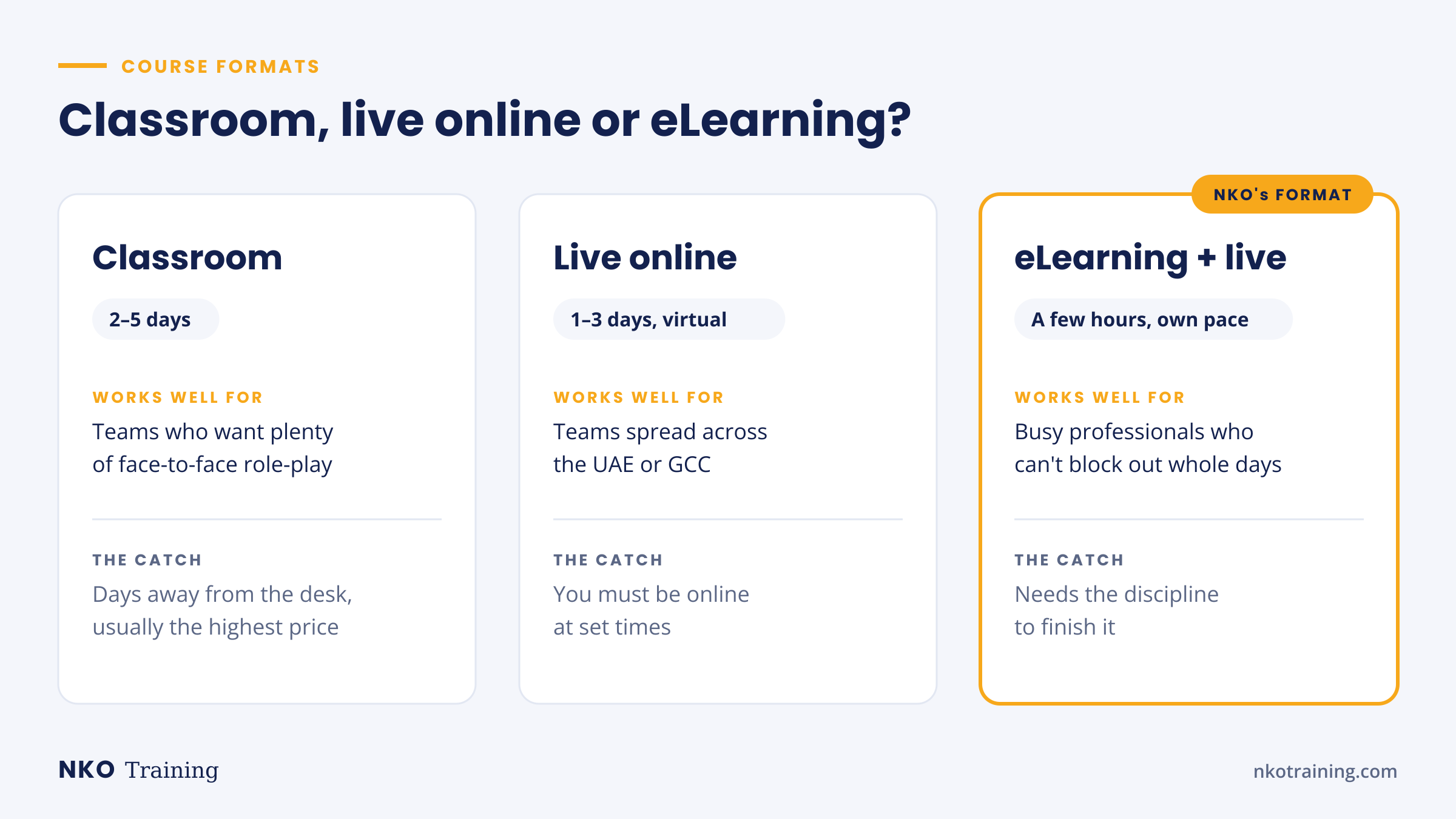
Classroom
- Usual length
- 2–5 days
- Works well for
- Teams who want plenty of face-to-face role-play
- The catch
- Days away from the desk, and usually the highest price
Live online
- Usual length
- 1–3 days of virtual sessions
- Works well for
- Teams spread across the UAE or GCC
- The catch
- You have to be online at set times
eLearning with a live assessment
- Usual length
- A few hours, at your own pace
- Works well for
- Busy professionals who can't block out whole days
- The catch
- You need the discipline to actually finish it
For a lot of working professionals, the last option is the sweet spot. You learn in your own time, then prove you can use it in a live session with a real person.
How do you pick a negotiation course that's worth it?
Before you pay for anything, ask a few blunt questions:
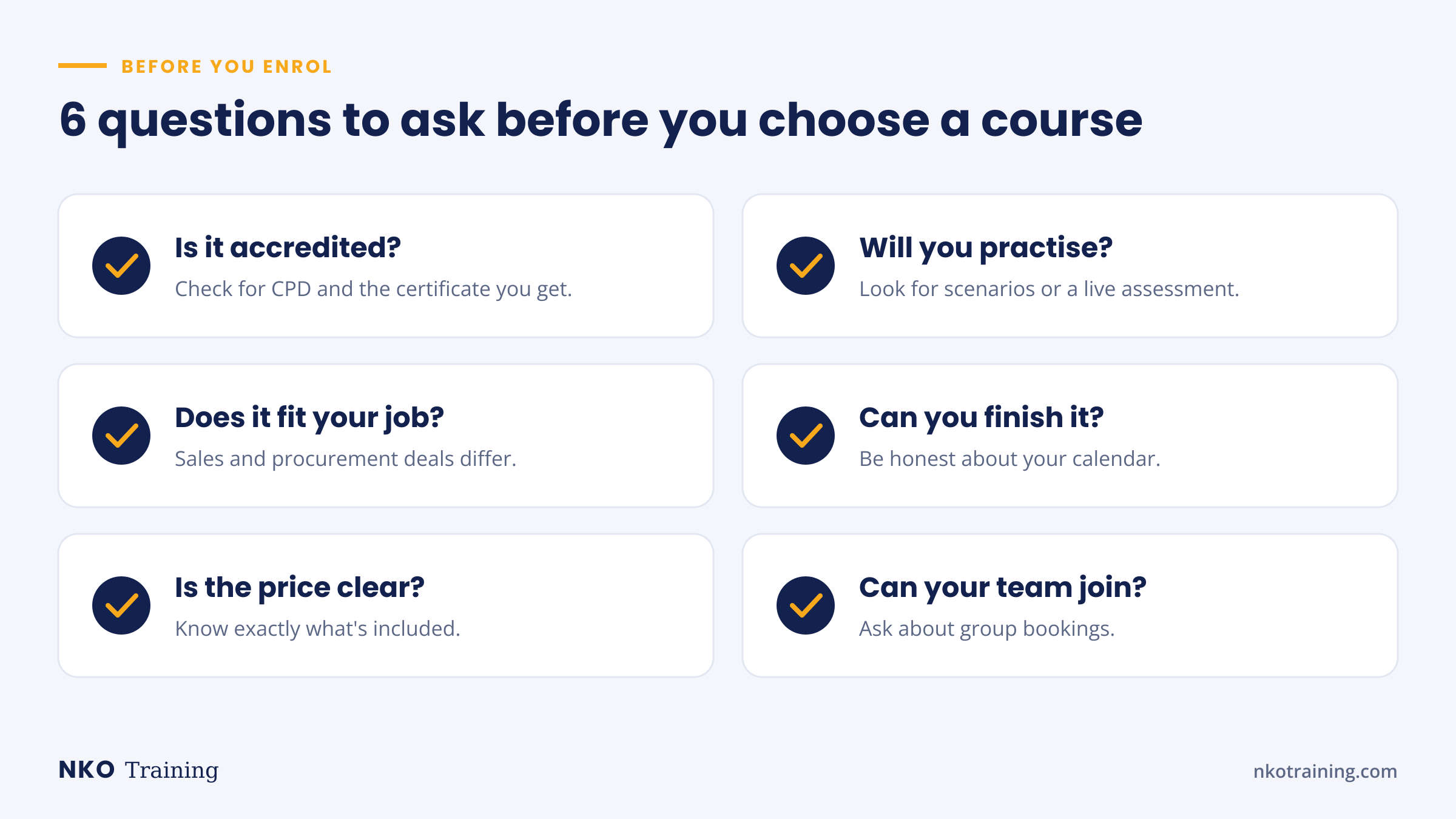
- Is it accredited? CPD accreditation means someone independent has reviewed the course. Check what certificate you'll actually receive.
- Will you practise, or just watch? Theory alone won't help when a buyer pushes back. Look for scenarios, role-play or a live assessment.
- Does it fit your job? A procurement negotiation isn't the same as a sales one, so the examples should look like your work.
- Can you realistically finish it? Be honest about your calendar.
- Is the price clear? You should know exactly what's included.
- Can your team join? If you manage people, ask about group bookings.
If you're comparing providers more broadly, our article on how to choose an accredited corporate training provider in Dubai goes into more detail.
About our Negotiation Skills course
We built our Negotiation Skills course for people who don't have a week to spare but still want to walk out negotiating better. Here's what you get:
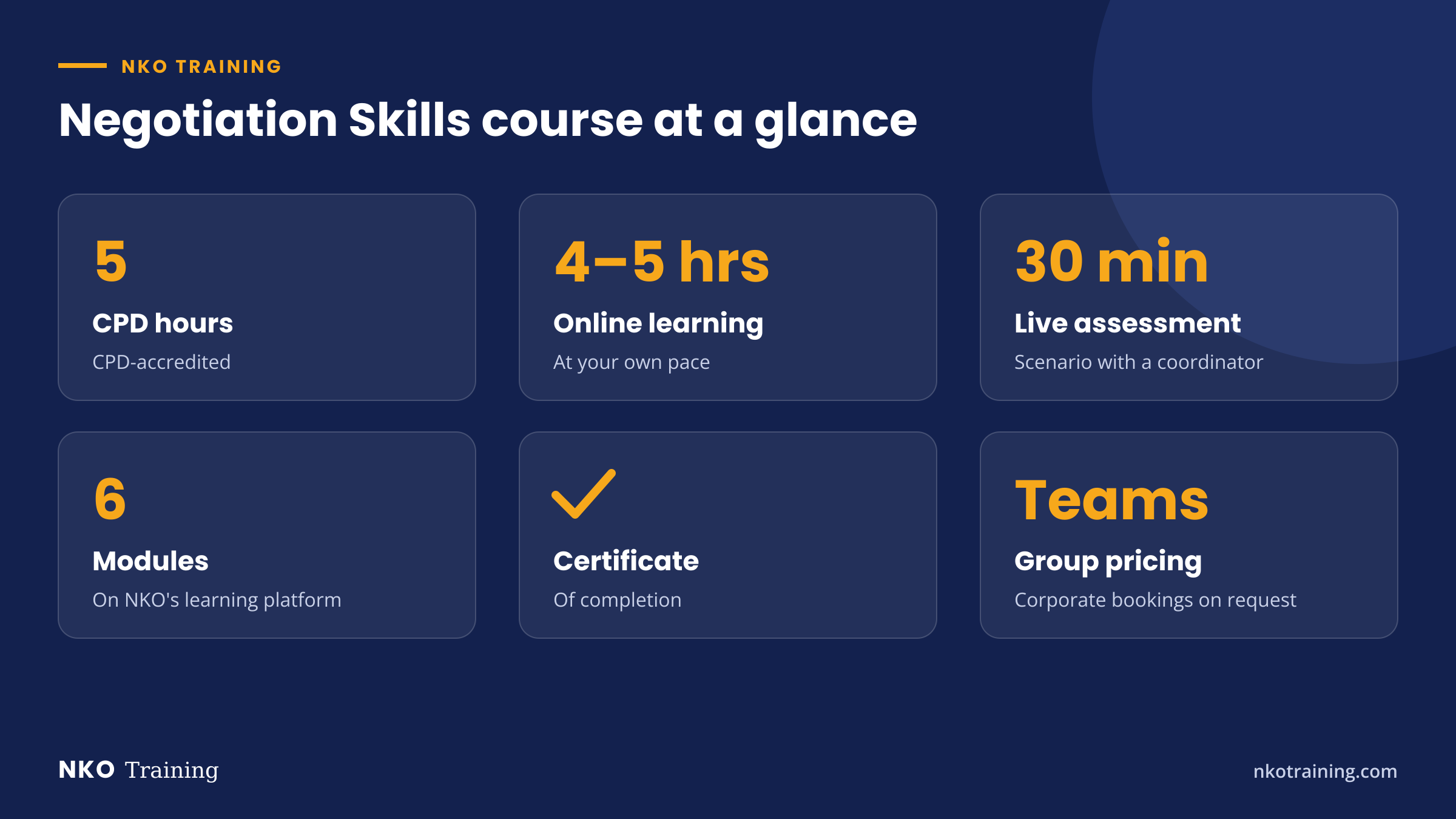
- Accreditation: CPD-accredited, 5 CPD hours
- Format: 4–5 hours of self-paced eLearning, plus a 30-minute live scenario and assessment with a course coordinator
- Structure: 6 modules on NKO's online learning platform
- Certificate: Certificate of Completion once all requirements are met
- Fee: US$700 excluding VAT at the time of writing, with group and corporate pricing on request
It's a good fit if you're a manager or team leader, work in sales, procurement or account management, run your own business, or simply want to feel calmer the next time money comes up in a meeting.
If your bigger goal is winning more business overall, it pairs well with our Professional Sales Skills course, which covers prospecting, discovery and closing.
Ready to stop giving away discounts?
Every discount you don't give, and every better term you secure, goes straight to the bottom line. The good news is that negotiation isn't a talent you're born with. It's a skill, and it gets better with a clear method and a bit of practice.
Enrol in the Negotiation Skills course today, or book a free consultation if you'd like to talk about training for your whole team.
Frequently asked questions
What is the best negotiation course in Dubai?
It depends on what you negotiate and how much time you have. Look for three things: CPD accreditation, real practice through scenarios or a live assessment, and examples that match your job. NKO Training's Negotiation Skills course ticks all three: it's CPD-accredited for 5 CPD hours and combines 4–5 hours of online learning with a 30-minute live assessment.
How long does a negotiation skills course take?
Classroom programmes in Dubai usually run for 2–5 days. Online courses are much shorter. NKO Training's Negotiation Skills course takes 4–5 hours of self-paced learning, plus a 30-minute live scenario and assessment, so you can fit it around your job.
Is CPD accreditation recognised in the UAE?
CPD accreditation tells you the course has been independently reviewed against continuing professional development standards. Whether the hours count towards a specific requirement is up to your employer or professional body, so it's worth checking with them first.
What is BATNA in negotiation?
BATNA means Best Alternative To a Negotiated Agreement. It's your plan B: what you'll do if this deal doesn't happen, such as switching to another supplier. Knowing it tells you when to walk away, and gives you more confidence at the table.
Can I take a negotiation skills course online in Dubai?
Yes. NKO Training's Negotiation Skills course is fully online. You work through the eLearning at your own pace, then join a live online scenario and assessment with a course coordinator.
How much does a negotiation skills course cost in Dubai?
It varies a lot. Shorter online courses start at around US$500, while multi-day classroom programmes can cost around US$6,000. NKO Training's Negotiation Skills course is US$700 excluding VAT, with group and corporate pricing on request.