
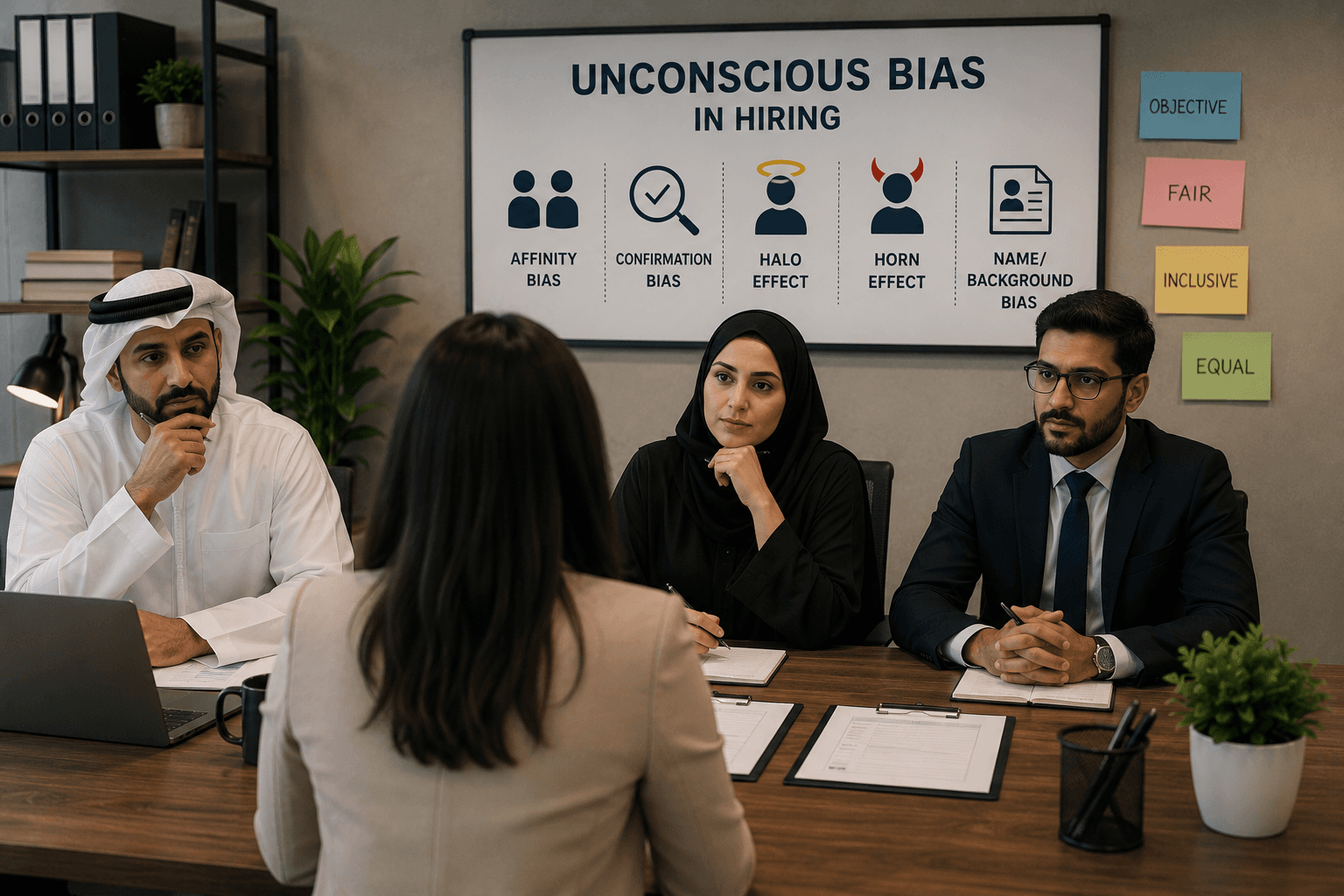
What is unconscious bias in hiring?
Unconscious bias in hiring means forming opinions about candidates without being fully aware of the reason behind those opinions. These opinions may be influenced by a candidate’s name, background, education, communication style, age, gender, nationality, or similarity to the interviewer.
In simple terms, unconscious bias can make hiring decisions less objective. Instead of focusing only on skills, experience, and role requirements, the decision may be affected by personal assumptions.
Bias does not always come from bad intentions. However, it can still create unfair outcomes if companies do not manage it properly.
Why hiring bias affects workplace diversity
Hiring bias can reduce workplace diversity because it may lead companies to choose candidates who look, speak, think, or behave like existing employees.
This can limit different perspectives and reduce creativity, problem-solving, and innovation. It may also make qualified candidates feel excluded from the process.
For UAE workplaces, where teams often include people from different cultures, nationalities, and professional backgrounds, fair hiring practices are especially important. Reducing bias helps companies build stronger, more inclusive teams.
Common unconscious biases in hiring decisions
There are several types of unconscious bias that can affect recruitment. Some appear during CV screening, while others happen during interviews, shortlisting, or final selection.
The most common biases include affinity bias, confirmation bias, halo effect, horn effect, and name or background bias.
Affinity bias
Affinity bias happens when an interviewer prefers a candidate because they share something in common. This may include the same university, previous employer, nationality, interests, personality style, or communication approach.
For example, a hiring manager may feel more comfortable with a candidate who reminds them of themselves. This can make the candidate seem stronger, even if another applicant is more qualified.
To reduce affinity bias, companies should use clear selection criteria and structured interview questions.
Confirmation bias
Confirmation bias happens when a recruiter forms an early opinion about a candidate and then looks for information that supports that opinion.
For example, if an interviewer believes a candidate is confident based on the first few minutes, they may focus only on positive answers and ignore weak points. The opposite can also happen if the first impression is negative.
Recruiters should review evidence carefully and avoid making decisions too early in the process.
Halo effect
The halo effect happens when one strong quality makes the candidate appear better overall. For example, a candidate may have worked for a well-known company, studied at a respected university, or speak very confidently during the interview.
Because of that one positive factor, the interviewer may assume the candidate is strong in other areas without enough evidence.
To avoid this, interviewers should assess each skill separately and compare it to the job requirements.
Horn effect
The horn effect is the opposite of the halo effect. It happens when one negative detail affects the whole opinion of the candidate.
For example, a candidate may be nervous at the beginning of the interview or have a gap in their CV. The interviewer may then assume they are not suitable, even if they have the right experience and skills.
Interviewers should look at the full candidate profile before making a decision.
Name or background bias
Name or background bias happens when assumptions are made based on a candidate’s name, nationality, accent, school, location, or personal background.
This can affect CV screening and interview decisions, even when the candidate meets the job requirements.
Companies can reduce this bias by focusing on skills, experience, role fit, and measurable criteria instead of personal background details.
Examples of unconscious bias in recruitment
Unconscious bias may appear in simple recruitment situations. A recruiter may shortlist candidates from familiar universities more often. A manager may prefer candidates with similar communication styles. An interviewer may judge a candidate too strongly based on confidence rather than actual ability.
Another example is assuming that a candidate with a career break is less committed, without asking fair questions about their experience and readiness for the role.
These examples show why structured recruitment is important.
How companies can reduce hiring bias
Companies can reduce hiring bias by using clear job descriptions, structured interviews, scoring systems, and diverse interview panels.
Recruiters should define role requirements before reviewing candidates. Interviewers should ask the same core questions to all applicants and score answers based on evidence.
It is also helpful to review shortlists for patterns. If certain groups are often excluded, the recruitment process may need improvement.
How training supports fairer hiring decisions
Training helps recruiters, HR teams, and managers understand how unconscious bias affects hiring. It gives them practical tools to recognize bias, ask fair questions, assess candidates objectively, and make better decisions.
Training also supports inclusive hiring practices and helps companies create more consistent recruitment standards.
NKO Training supports professionals and organizations with workplace training programs that improve communication, leadership, diversity awareness, and professional decision-making.
FAQs about unconscious bias in hiring
What is an example of unconscious bias in hiring? An example is preferring a candidate because they studied at the same university as the interviewer, rather than because they are the best fit for the role.
Can unconscious bias be completely removed? It may not be removed completely, but companies can reduce its impact through structured interviews, clear criteria, diverse panels, and training.
Why is unconscious bias training important for recruiters? It helps recruiters recognize hidden assumptions, assess candidates more fairly, and support better hiring decisions.
- #Common Unconscious Biases
- #unconscious bias in the workplace
- #unconscious bias meaning
- #unconscious bias example
- #unconscious bias at work