
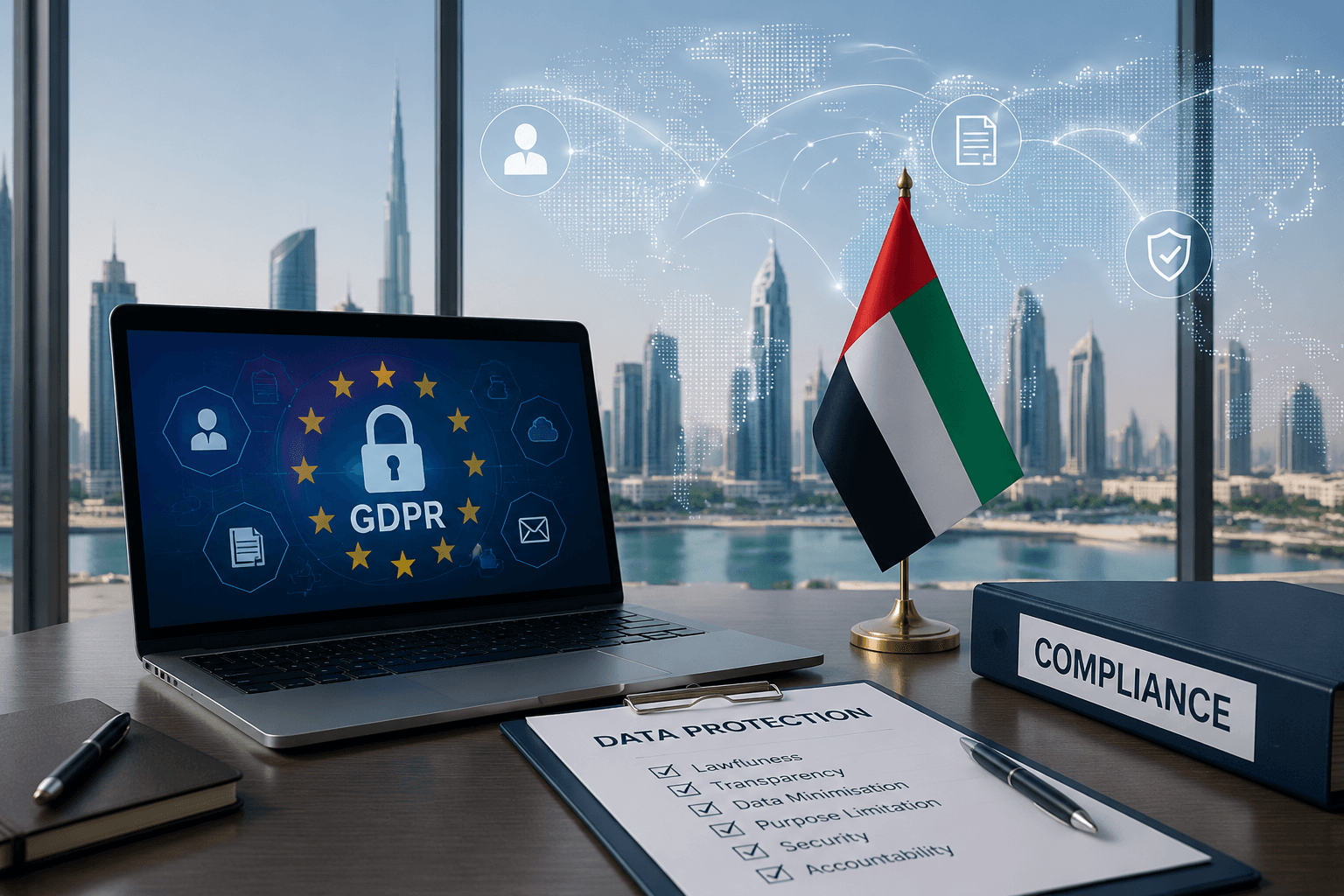
Does GDPR apply to UAE companies? Yes. It can apply when a UAE business has an establishment in the EU, offers goods or services to individuals in the EU, or monitors their behaviour there. Depending on its location, sector, and processing activities, the business may also fall under the UAE Federal Personal Data Protection Law, a free-zone data protection law, or sector-specific rules.
Understanding the GDPR
The General Data Protection Regulation is the European Union’s main personal data framework. It governs how organisations collect, use, share, store, secure, and delete information about identifiable individuals.
Its seven principles are lawfulness, fairness and transparency; purpose limitation; data minimisation; accuracy; storage limitation; integrity and confidentiality; and accountability. Individuals also receive rights concerning access, correction, erasure, restriction, portability, objection, and automated decisions.
Compliance requires more than a privacy notice. Businesses need a lawful basis, security, clear responsibilities, response procedures, and records demonstrating that controls work.
What Counts as Personal Data and Processing Under GDPR?
Personal data is information relating to an identified or identifiable living person. Examples include:
- Names, identification numbers, and contact details
- Named business email addresses
- IP addresses, cookie identifiers, and location data
- Customer, employee, payroll, and recruitment records
- Photographs, CCTV footage, and recorded calls
Pseudonymised or encrypted information remains personal data when re-identification is possible. Irreversibly anonymised data generally falls outside the GDPR.
“Processing” includes collecting, recording, storing, viewing, analysing, changing, sharing, transferring, restricting, deleting, or destroying data. A UAE company may process EU personal data through analytics, recruitment platforms, cloud services, CRM systems, marketing tools, or outsourced payroll.
What Is Special Category Data and How Is It Handled?
Special category data includes information revealing racial or ethnic origin, political opinions, religious or philosophical beliefs, trade-union membership, genetic data, biometric identification data, health information, and data concerning sex life or sexual orientation.
Its processing is generally prohibited unless a specific exception applies, such as explicit consent, employment obligations, vital interests, legal claims, substantial public interest, healthcare, public health, or qualifying research.
Businesses should restrict access, strengthen security, document an Article 6 lawful basis and an Article 9 condition, and consider a data protection impact assessment for high-risk processing.
When Does GDPR Apply to a UAE Company?
The GDPR may apply in three main situations:
- EU establishment: Processing is connected with a branch, office, or other establishment in the EU.
- Offering goods or services: The company intentionally offers goods or services to individuals in the EU.
- Monitoring behaviour: The company tracks or profiles behaviour taking place in the EU.
The rule concerns individuals in the EU during the activity, not only EU citizens. Website accessibility alone is insufficient. Targeting indicators may include EU advertising, local currencies, delivery options, country-specific domains, or targeted campaigns.
A covered UAE business may also need an EU representative unless an exception applies. Its duties depend on whether it acts as a controller, processor, or joint controller.
GDPR vs. UAE Federal Data Protection Law (PDPL): Key Differences & Similarities
Scope:
GDPR covers EU establishments and certain non-EU organisations targeting or monitoring individuals in the EU. UAE Federal PDPL covers UAE-based controllers and processors and certain overseas processing involving individuals in the UAE, subject to exclusions.
Legal grounds:
GDPR provides six lawful bases and additional conditions for special category data. UAE Federal PDPL starts from consent but permits processing without consent in specific cases, including contracts, legal obligations, public interest, employment, and legal claims.
Rights:
GDPR includes access, correction, erasure, restriction, portability, objection, and automated-decision protections. UAE Federal PDPL provides broadly comparable rights, including information, transfer, correction, erasure, restriction, objection, and review of certain automated processing.
DPO:
GDPR requires a Data Protection Officer (DPO) for public authorities or bodies, except courts acting in their judicial capacity, or where core activities involve large-scale regular and systematic monitoring or large-scale processing of special category or criminal conviction data. UAE Federal PDPL requires a DPO where processing creates a high risk because of new technologies or data volume, involves systematic and comprehensive assessment or profiling, or involves large volumes of sensitive personal data.
Breaches:
Under GDPR, notification may be required within 72 hours where a breach risks individuals’ rights and freedoms. UAE Federal PDPL requires notification duties where a breach may prejudice privacy, confidentiality, or data security.
Transfers:
GDPR uses adequacy decisions, Standard Contractual Clauses, and other permitted safeguards for international transfers. UAE Federal PDPL regulates transfers through recognised protection levels, safeguards, and specified exceptions.
Both frameworks emphasise transparency, minimisation, security, rights, accountability, and controlled transfers. GDPR compliance, however, does not automatically satisfy every UAE requirement.
The federal PDPL excludes companies and establishments in UAE free zones that have their own data protection legislation. Businesses in the DIFC or ADGM must assess the rules applicable in those jurisdictions. Government data and certain health, banking, and credit data may also fall under separate legislation.
The European Commission has not adopted an adequacy decision for the UAE. Transfers of personal data from the European Economic Area to UAE recipients may therefore require Standard Contractual Clauses or another valid transfer mechanism, together with any necessary supplementary safeguards.
The Cost of Non-Compliance
Certain serious GDPR infringements can lead to fines of up to €20 million or 4% of total annual worldwide turnover from the preceding financial year, whichever is higher. Regulators may also issue warnings, reprimands, corrective orders, or processing bans.
Additional costs may include breach response, legal claims, disruption, delayed contracts, failed vendor reviews, customer loss, and reputational damage. UAE businesses may also face consequences under applicable federal, free-zone, sector, or contractual rules.
How UAE Businesses Can Achieve GDPR and UAE PDPL Compliance?
A practical compliance programme should:
- Map personal data, purposes, systems, recipients, locations, and retention periods.
- Confirm which laws apply to each entity and processing activity.
- Document lawful bases and special-category processing conditions.
- Update privacy notices, cookie controls, consent wording, and marketing procedures.
- Create processes for individual rights requests.
- Review processors, cloud providers, contracts, and international transfers.
- Apply privacy by design, access controls, encryption, secure deletion, and breach-response procedures.
- Assess whether a DPO, EU representative, DPIA, or processing record is required.
- Train employees and retain evidence of policies, incidents, and corrective actions.
Training matters because privacy failures often begin with everyday decisions by HR, sales, marketing, customer service, and IT teams. Employees should understand what personal data is, when it may be shared, how to recognise an incident, and where to escalate concerns.
NKO Training’s International Compliance, Governance & Ethics programme covers compliance culture, governance frameworks, risk management, and internal controls. Its IT and Technical Skills programme includes cybersecurity, data management, IT governance, and compliance.
These programmes can strengthen awareness, while complex processing may still require legal advice. Businesses can also book a free consultation with NKO Training to discuss their team’s professional development needs and choose a suitable online, hybrid, or in-person training format.
FAQ
Is GDPR applicable to companies?
Yes. It can apply to private companies, public bodies, non-profits, and organisations of any size when their activities fall within its scope. A UAE company may be covered through an EU establishment, targeted goods or services, or monitoring involving individuals in the EU.
What are the 7 GDPR requirements?
The phrase usually refers to the seven GDPR principles:
- Lawfulness, fairness, and transparency
- Purpose limitation
- Data minimisation
- Accuracy
- Storage limitation
- Integrity and confidentiality
- Accountability
Organisations must apply these principles and demonstrate compliance through policies, records, contracts, security controls, and training.
This article provides general information and does not constitute legal advice. Businesses should obtain professional advice based on their activities, sector, jurisdiction, free-zone status, and international data flows.
- #Does GDPR Apply to UAE Companies
- #Understanding the GDPR
- #Special Category Data
- #When Does GDPR Apply to a UAE Company
- #How UAE Businesses Can Achieve GDPR